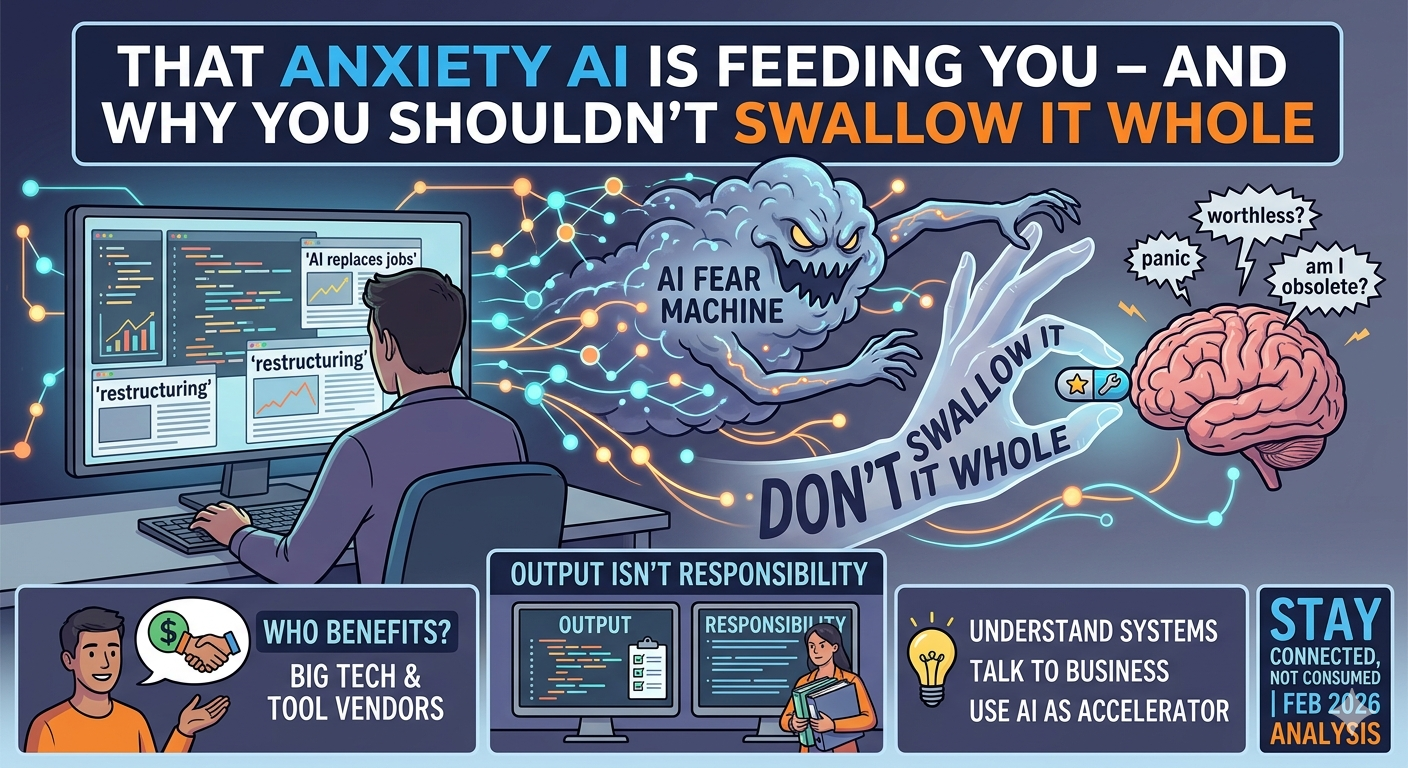
Let’s talk about that knot in your stomach.
You open LinkedIn. Another post about a company “restructuring” after replacing half their engineering team with AI agents. You open Twitter. Some tech bro is tweeting that “coding is dead” and if you’re not using Cursor 24/7, you’re already obsolete. You open the news. Headlines screaming that by 2027, AI will do 80% of what developers do today.
And you feel it. That quiet, creeping panic. The one that whispers at 2 AM: “What if I’m the one they let go? What if everything I learned is now worthless?”
Let’s be real. That anxiety isn’t accidental. It’s being manufactured, amplified, and served to you on a silver platter—because anxiety sells subscriptions, engagement, and most importantly, acceptance of lower wages.
The Fear Machine Is Running at Full Speed
Who benefits when you’re scared?
Nobody’s going to tell you, “Relax, you’ve got time.” That doesn’t sell.
So instead, you get a constant drip of apocalyptic takes. And if you’re not careful, you start internalizing them. You start believing that your craft—the thing you spent years learning—is about to be automated into oblivion.
Let’s Separate Reality from Noise
Here’s what the fear mongering doesn’t tell you:
1. AI is not autonomous. It’s a turbocharged autocomplete.
It doesn’t understand requirements. It doesn’t understand trade-offs. It doesn’t understand the sheer chaos of real-world systems—the weird business rules, the technical debt, the political constraints inside a company. It generates text that looks correct. Looking correct and being correct in production are two different universes.
2. The “replacement” narrative confuses output with responsibility.
Yes, AI can generate code faster. But who signs off on that code? Who owns the security risk? Who wakes up at 3 AM when the payment system goes down? Who explains to the client why the feature can’t be delivered the way they imagined?
AI doesn’t take responsibility. It doesn’t get fired. It doesn’t go to meetings and manage stakeholders. It’s a tool. A sharp one, but still a tool.
3. If AI truly replaced developers, the first people to go would be the executives promoting it.
Think about it: If AI could actually handle complex software projects from start to finish, why would Zuckerberg need thousands of engineers at Meta right now? Why is every AI company still hiring humans like crazy? Because they know the limits. They talk about replacement to keep the stock price high and the workforce pliable.
The Anxiety Is Real – But It’s Misplaced
You’re not wrong to feel uneasy. Change is unsettling. But the real question isn’t “Will AI replace me?” The real question is: “Am I staying ahead of the curve, or am I standing still?”
The developers who should be worried are the ones who haven’t learned anything new in five years. The ones who treat their job as “I write the tickets I’m given and nothing more.” Those people were already at risk before AI. AI just accelerated the timeline.
The developers who aren’t worried? They’re the ones who:
What to Do With That Anxiety
Instead of letting it paralyze you, let it redirect you.
Straight to the Point
That anxiety you’re feeling? It’s not a sign you’re about to be replaced. It’s a sign you care about your career. That’s good. But don’t let the noise turn that care into fear.
AI is not the antigravity that will float your job away. It’s the power tool that will let you build faster—if you decide to pick it up.
The ones who will struggle are the ones who sit back, paralyzed, waiting to see what happens. The ones who adapt, learn, and stay curious? They’ll be fine. More than fine.
So take a breath. Ignore the doom-scroll. Keep building. Keep learning. And stop letting billionaire CEOs live rent-free in your head.
They’re not losing sleep over you. Don’t lose yours over them.